NEVER USE AN EM DASH!
Or A student's guide to writing in the age of AI

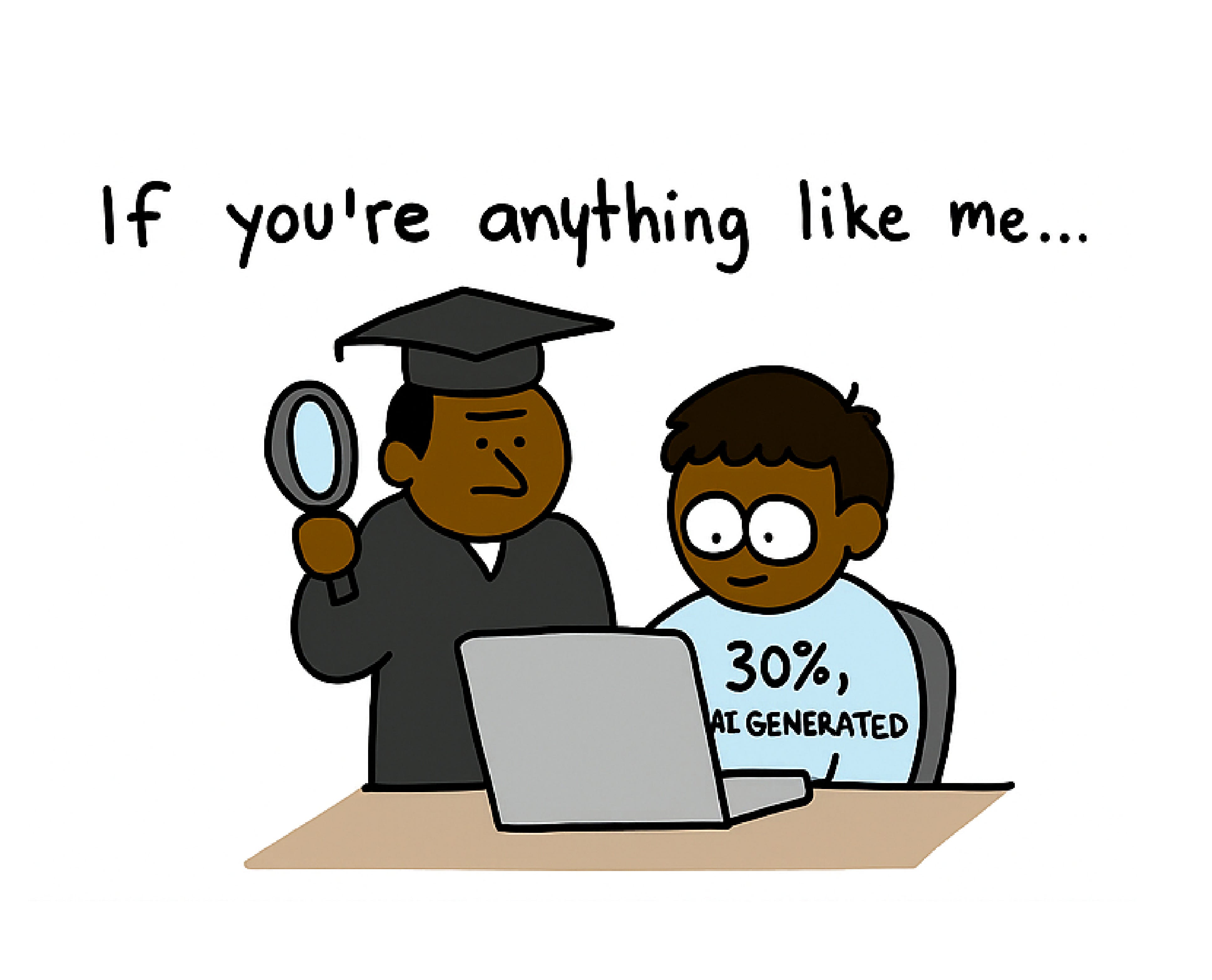
If you’re anything like me, you understand the panic-induced nightmare of sitting for an hour and a half, drafting your assignment, only for your professor’s AI detector to come back with 30% AI generated. You didn’t ask ChatGPT to write your thesis on the metaphysical implications of whatever, maybe you just asked it to rephrase a sentence. Or maybe you made use of Grammarly which, turns out, is an AI driven software and the next thing you know, your paper is laden with AI’s all-seeing “human sounding” prose and now you’re the criminal.
But fear not! This is not about avoiding AI at all costs (impossible) but rather, about acknowledging the tool and understanding how it learns language so you, with your superior brain and human sensibilities can maintain your voice and (by the way) successfully pass any disciplinary AI detectors. Because while AI may be growing more advanced at rapid speed, and AI detector technology has trained itself to detect even GPT-5 or whatever, that which the human mind creates is still inherently unmatched. AI, no matter how many resources it has at its digital fingertips, will never know what a human writer knows.
So let us delve (almost slipped!) into how to avoid sounding like a robot trying to be a human.
The Writing Style of a Robot
Here’s the deal with AI: it has patterns. Some very glaring ones once you learn what to look for.
More and more, professors have become their own walking, breathing AI detectors, noting certain verbiage and stylistic tics that scream “I was created by an algorithm!” These software learn from vast sources across the internet in exponential time so it’s no wonder they default to specific options. The thing is, AI relies on predictive analytics and likelihood, not human decency or comprehension.
And so an “AI feel” emerges. And that’s not good. It might even be bad if I may add.
Identifying the Silicon Signature in Your Work
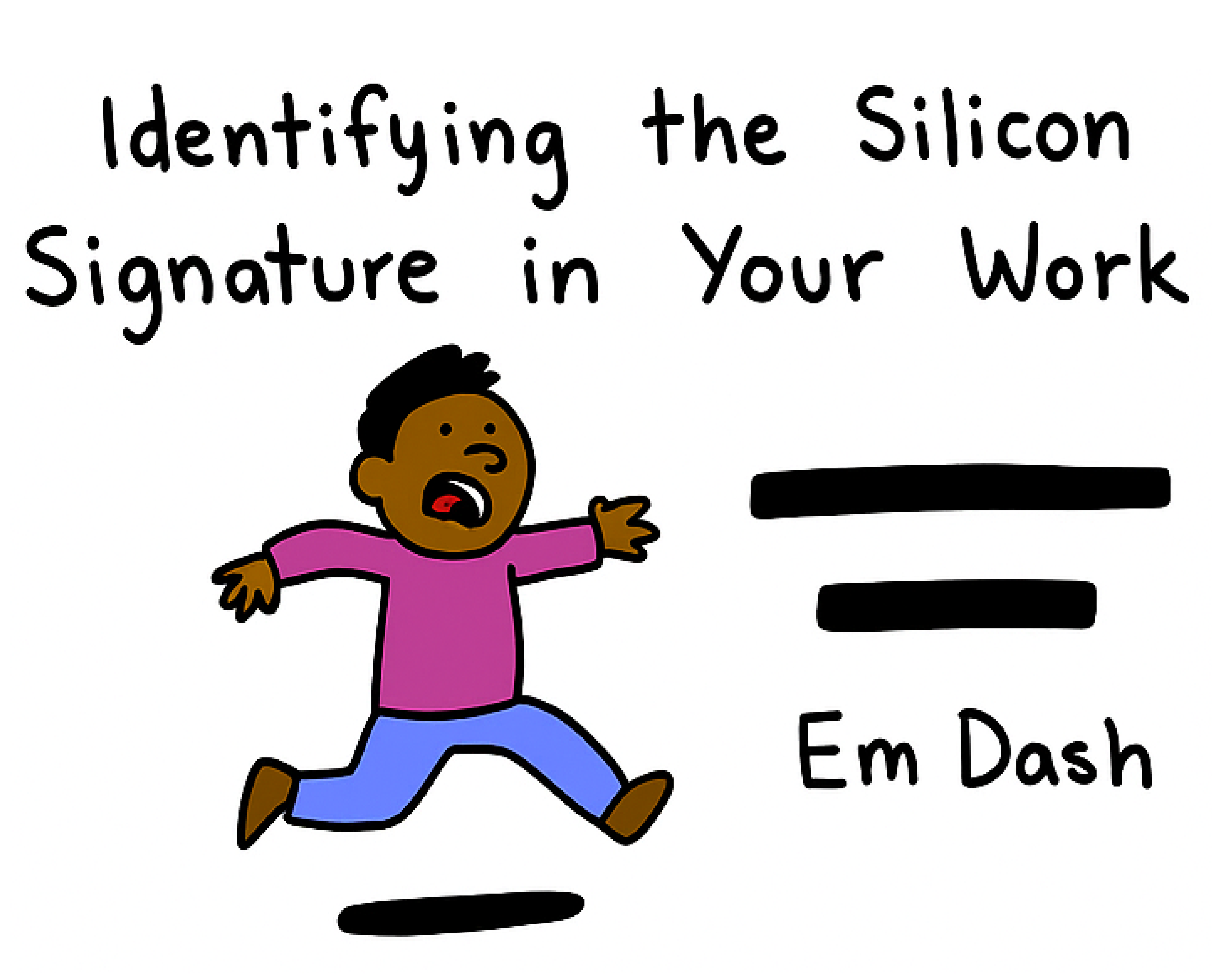
Let’s get straight to the point: NEVER USE AN EM DASH.
I’m not being dramatic or overreacting, it’s time to make it an archaism beacause AI models use them way more than the average person ever does. GPT loves colons and proper quotation marks, whereas Claude tends to have straight quotation marks. So if your paper looks like a typography guide, you’re stepping a bit too far on the AI side
This may be the biggest tip off. AI models love using certain “sophisticated” words to make themselves sound…sophisticated. If you have these words at the ready at any point, ditch the thesaurus and slowly walk away:
“Delve,” “foster,” “elevate,” “nuanced,” “intricate,” “tapestry,” “underscore,” “pivotal,” “multifaceted,” “profound,” “resonate.”
And the real killers: “embark,” “embrace,” “enrich,” “navigate,” “revolutionize,” “paramount,” “realm,” “transformative,” “illuminate,” “vibrant,” “testament,” and good old “utilize.”
This will probably flag my essay as AI generated if you put it through a detector… I’m not kidding, these words cluster in in AI text like tourists at anywhere with a good view.
The Secret Formula
When writing, most people avoid:
Incredibly specific, albeit redundant, grammar and structure. Equalized paragraphs where every paragraph has precisely three sentences. While good grammar is good, AI’s version of “good grammar” seems forced and unnatural. Artificial even.
Random
bullet points
and
bolded words
that have no relevance to the content whatsoever. General introductions that waste your time getting to the point, like politicians without the promises of change.
Introductions filled with redundancies. The acknowledgment of the same concept in multiple places versus expanding upon an idea. Significant lack of transitions and made up transitions resulting in the forced use of colons and em dashes.
The conclusions are usually the worst. They present an entirely new idea in the last paragraph, something that was never acknowledged before and then misses the nuance it claims to dedicate it to. Almost like AI forgets what it’s doing in the first place.
The Human Advantage: What AI Can’t Fake (Yet)
As it currently stands, algorithms are a bit dumb. At their very core, the transformers and the web of networks and all that matrix multiplication cannot empathise, they lack emotions and the situational awareness that come with them. It cannot feel. Cannot use emotional intelligence. and cannot deploy a real understanding of context.
Regardless of what your AI therapist tells you, it has no true comprehension about what it is writing about. It can pretend to, though, the same way I can pretend I’m a soldier or a superhero or a good writer, albeit it has no unique voice or personal experience.
It lacks imagination.
The Verdict
Here’s what keeps me up at night: what if we forget how to be wrong?
Relying too heavily on AI risks losing the most basic of cognitive skills that render our writing meaningful. You get cognitive offloading, cognitive atrophy, digital dementia, and many more alliterative ailments, especially if you have no prior knowledge of what you’re attempting to convey through your writing.
We’re currently witnessing a generation of students who are producing technically proficient prose while simultaneously and fundamentally not engaging with ideas that make that writing worth writing in the first place.
We’re slowly teaching ourselves to think like computers. And you should be worried.
The algorithm doesn’t know what it’s like to stare at a blank page at 2 AM, wondering if anything you’ve ever thought was worth thinking. It doesn’t know what it’s like to find the exact wrong word that somehow says exactly what you mean.
And each time you let AI finish your thought, you teach your brain to quiet down a little bit sooner. Each perfectly curated sentence to sound like everyone else’s perfectly curated sentence puts us one step closer to a more boring world. We have a generation of children growing up to sound like they all went to the same $60,000 a year, painfully vanilla prep school.
Your weird brain, with its idiosyncrasies, inadequacies, fascinations and nonsensical leaps and random connective strands are what’s standing between us and a world where all things we read sounds like it was composed by a very polite, very competent committee.
So write. And when you do, be wrong sometimes. Be uncomfortable. Let your sentences veer off track and stumble over themselves. Use words that let you sound like you instead of sounding like someone else trying to sound like you.
We need people moving forward who can work with AI through collaboration but also distinction. Who know that every single earnest word put to paper is one more word that AI cannot replicate.
Sometimes your errors are not errors.
They’re proof that you’re still in your brain.